Between the ages of 2 and 5, children move through predictable physical, cognitive, social, emotional, and language milestones, often called preschool developmental stages. Every child reaches these at their own pace, but understanding what’s typical for each age helps parents choose age-appropriate learning experiences, spot developmental needs early, and support their child’s growth with confidence.
As a parent, you’ve probably found yourself comparing notes with other families. “Is my child talking as much as theirs?” or “Should they be able to hold a crayon like that by now?” It’s completely natural to wonder. The preschool years, roughly ages 2 to 5, are some of the most important years for brain development your child will ever experience, and knowing what to expect at each stage takes a lot of the guesswork (and worry) out of parenting.
Here’s what preschool developmental stages look like, what to expect at each age, and how a quality preschool program can support your child through every one of them.
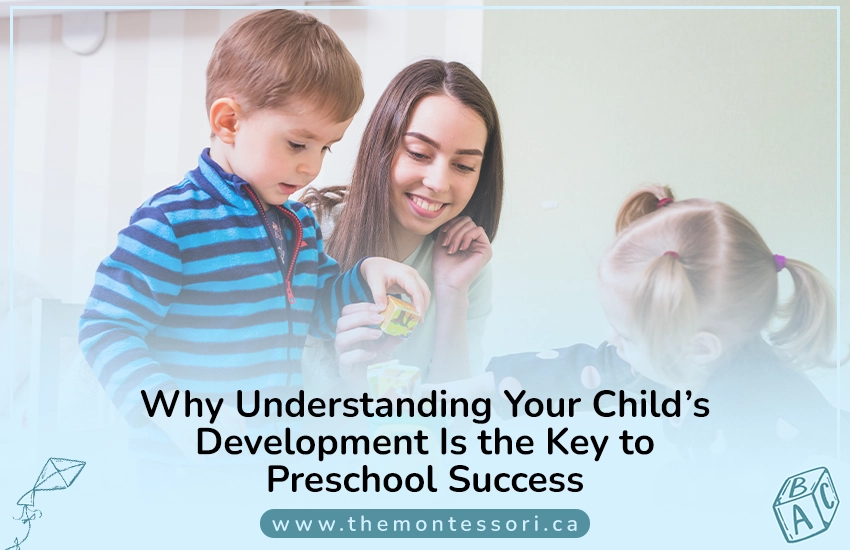
Why Understanding Your Child’s Development Is the Key to Preschool Success
Understanding preschool developmental stages takes away that guesswork. It gives you a clear picture of what to expect physically, cognitively, socially, emotionally, and linguistically between ages 2 and 5. Once you know what typical development looks like, you’re in a much better position to choose the right learning environment and support your child at home too.
What Are Preschool Developmental Stages?
Preschool developmental stages are the typical patterns of growth children go through between toddlerhood and kindergarten. They cover five main areas:
- Physical development (movement and coordination)
- Cognitive development (thinking and problem-solving)
- Language development (speaking and understanding)
- Social development (relating to others)
- Emotional development (understanding and managing feelings)
These stages aren’t a rigid checklist. They’re more like a general roadmap that helps parents and educators know what kind of support a child needs at any given point.
Why Every Child Develops at Their Own Pace
No two children hit milestones on exactly the same timeline, and that’s completely normal. Genetics, environment, temperament, and even birth order can all play a role in when a child starts talking in full sentences or feels confident sharing toys with a friend. Milestones are guides, not deadlines. They’re meant to help you notice patterns, not create pressure.
Why the Preschool Years Are Critical for Brain Development
Between ages 2 and 5, a child’s brain is developing faster than at almost any other point in life. This is when neural pathways for language, reasoning, and emotional regulation are being built through everyday experiences like play, conversation, exploration, and relationships. That’s exactly why the preschool years matter so much, and why the experiences a child has during this window can shape learning habits for years to come.
The Five Areas of Early Childhood Development Every Parent Should Know
Every skill your child builds during preschool fits into one of five categories:
- Physical: running, jumping, holding a pencil, using scissors
- Cognitive: counting, sorting, problem-solving, memory
- Language: vocabulary, sentence structure, listening skills
- Social: sharing, taking turns, making friends
- Emotional: naming feelings, managing frustration, building confidence
A well-rounded preschool experience nurtures all five areas together, not just one or two.
How Developmental Milestones Help Parents Support Learning
Once you know roughly what to expect at each age, you can offer the right kind of support at the right time, whether that’s more hands-on play for a toddler working on fine motor skills, or more conversation and storytelling for a child building vocabulary. Milestones essentially give you a head start on knowing how to help.
Why Comparing Your Child to Others Can Be Misleading
It’s easy to fall into the comparison trap, especially in group settings like playdates or daycare pickup. But development isn’t a race, and a child who’s a little behind in one area is often ahead in another. Focusing on your own child’s steady progress, rather than comparing them to a sibling, cousin, or classmate, is a much healthier (and more accurate) way to track growth.
The Parent’s Role in Early Childhood Development
Parents are a child’s first and most important teachers. Everyday moments, like mealtime conversations, bedtime stories, and grocery store counting games, all contribute to development just as much as structured learning does. Pairing that everyday support with a quality preschool program gives your child the best of both worlds.
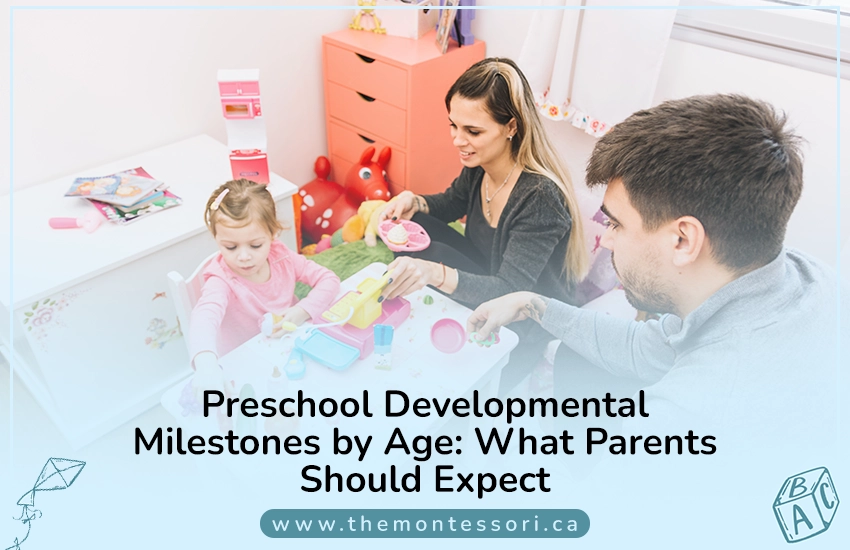
Preschool Developmental Milestones by Age: What Parents Should Expect
While every child grows at their own pace, there are general patterns most children follow between ages 2 and 5. Knowing what’s typical for each age group can help you understand where your child is at right now and what’s likely coming next.
Developmental Milestones for 2-Year-Olds
- Says short phrases and simple sentences
- Follows two-step instructions
- Enjoys parallel play alongside other children
- Shows big emotions and is beginning to name them
- Can run, climb, and kick a ball
Developmental Milestones for 3-Year-Olds
- Speaks in longer sentences and asks lots of “why” questions
- Begins to share and take turns with support
- Sorts objects by shape or colour
- Uses utensils and starts dressing with help
- Shows early imaginative play
Developmental Milestones for 4-Year-Olds
- Tells simple stories and follows multi-step instructions
- Plays cooperatively and starts forming friendships
- Counts small groups of objects
- Draws recognizable shapes and figures
- Manages basic self-care tasks independently
Developmental Milestones for 5-Year-Olds
- Uses full, detailed sentences and expanding vocabulary
- Understands rules and turn-taking in group games
- Recognizes some letters and numbers
- Demonstrates strong balance, coordination, and fine motor control
- Shows growing independence and self-confidence
Physical Development During Preschool Years
Physical growth during preschool covers both gross motor skills (running, jumping, climbing) and fine motor skills (drawing, cutting, buttoning). Daily active play is one of the best ways to build strength, coordination, and body awareness.
Cognitive Development: Thinking, Memory & Problem-Solving
Preschoolers are natural problem-solvers. Puzzles, sorting games, and simple cause-and-effect activities all help build memory, attention span, and early reasoning skills that support later academic learning.
Language and Communication Development
Vocabulary explodes during the preschool years. Reading together, singing, and simply narrating your day out loud all help children build the language skills they’ll rely on for reading and writing later on.
Social and Emotional Development
Learning to share, wait for a turn, and manage disappointment are some of the biggest (and hardest) lessons of the preschool years. These skills develop through practice, especially in group settings with peers and guidance from caring adults.
Fine Motor and Gross Motor Skill Development
Fine motor skills (holding a crayon, using scissors, stacking blocks) and gross motor skills (running, climbing, balancing) develop side by side. Both are essential for classroom readiness, from writing their name to sitting comfortably at a table.
Signs Your Child Is Ready for Preschool
- Can follow simple instructions
- Shows interest in playing near or with other children
- Manages basic routines like sitting for a short activity
- Communicates basic needs verbally
- Shows curiosity about new environments
Activities That Support Healthy Preschool Development at Home
- Reading together every day
- Simple sorting or matching games
- Outdoor play and free movement
- Encouraging pretend play
- Talking through daily routines and naming feelings
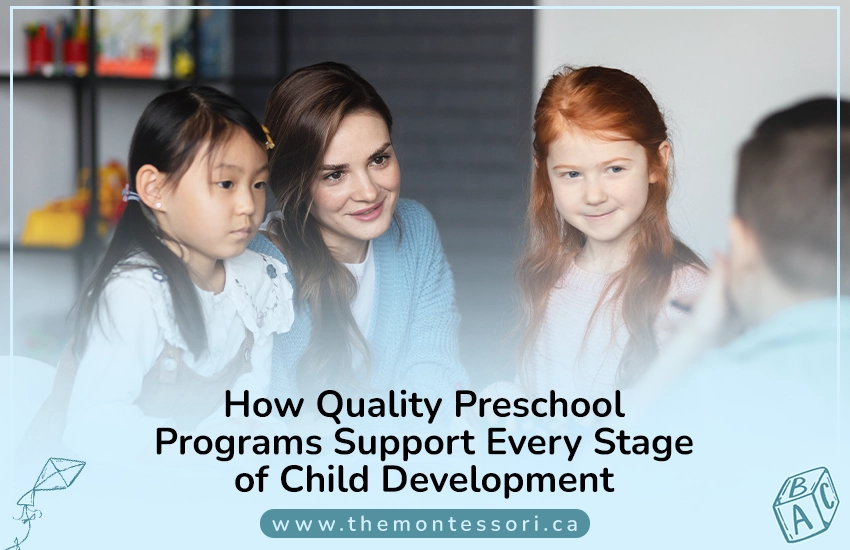
How Quality Preschool Programs Support Every Stage of Child Development
Knowing the milestones is only half the picture. The other half is understanding how a quality preschool program actually helps your child reach them. The best programs don’t just keep kids busy; they intentionally design activities and routines that build cognitive, social, emotional, and physical skills together. From the way play is structured to how teachers track progress, every part of a strong preschool experience should be working toward your child’s overall development.
How Preschool Encourages Cognitive Growth
A well-designed preschool program introduces new concepts gradually, building on what a child already knows. This steady progression helps children build confidence while stretching their thinking skills a little further each week.
Learning Through Play: Why It Matters
Play isn’t just fun; it’s how young children learn best. Through play, children practice problem-solving, negotiation, creativity, and language, often without even realizing they’re learning.
Montessori vs Traditional Preschool Development Approaches
Montessori programs tend to follow the child’s natural pace and interests, offering hands-on materials that let children explore concepts independently. Traditional programs often follow a more structured, teacher-led schedule. Both approaches can support development well, and the right fit depends on your child’s personality and learning style. Our Pre-School Program is built specifically around following each child’s individual developmental timeline.
Teacher-Guided vs Child-Led Learning
Some moments call for teacher guidance, like introducing a new skill, while others work best when a child leads their own exploration. A strong preschool program blends both, giving children structure without stifling curiosity.
How Preschool Builds Social Skills and Confidence
Group settings give children daily practice at sharing, taking turns, and resolving small conflicts, all under the guidance of caring, experienced educators. Over time, this builds genuine social confidence that carries into kindergarten and beyond.
How Creative Activities Improve Brain Development
Art, music, and imaginative play all strengthen the connections between different parts of the brain. Creative activities also give children a healthy outlet for expressing emotions they may not yet have the words for.
Why Mixed Learning Activities Support Whole-Child Development
A single activity rarely develops just one skill. Building a block tower, for example, supports fine motor skills, spatial reasoning, patience, and even social skills if it’s a group project. Preschools that mix activity types support the whole child, not just one area.
How Teachers Track Developmental Progress
Experienced educators regularly observe children during play and structured activities, noting progress across all five developmental areas. This ongoing observation helps teachers adjust activities to each child’s evolving needs, and you can see our structured Room Schedule.
When Should Parents Be Concerned About Developmental Delays?
If a child consistently isn’t reaching milestones for their age, for example, very limited speech by age 3, or difficulty interacting with other children by age 4, it’s worth discussing with your child’s teacher or pediatrician. Early support makes a real difference, and preschool educators are often the first to notice these patterns.
Questions Parents Should Ask About a Preschool’s Learning Program
- How do you track each child’s developmental progress?
- How is the daily schedule balanced between play and structured learning?
- How do teachers support children who need extra help in one area?
- How often will I receive updates on my child’s progress?
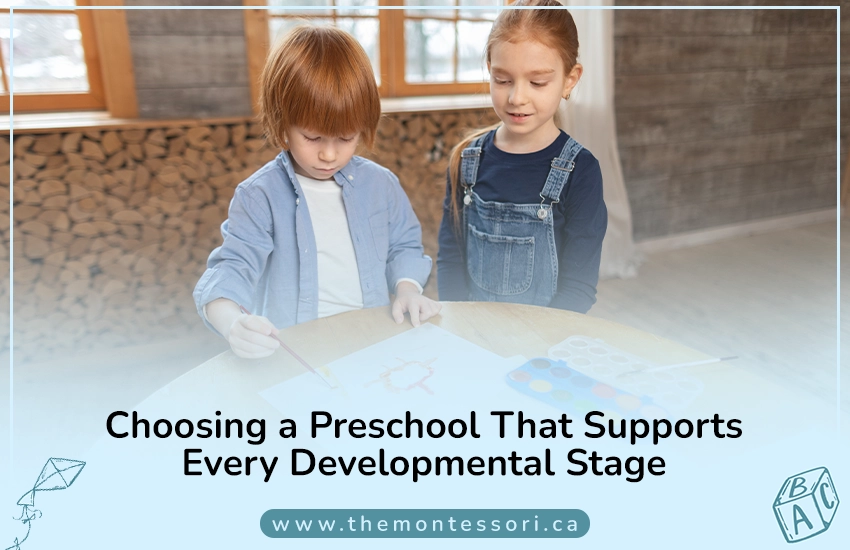
Choosing a Preschool That Supports Every Developmental Stage
Once you understand the stages of development and how quality programs support them, the next step is finding a preschool that actually delivers on that promise. Not every program is designed with true developmental support in mind, so it helps to know what to look for and what questions to ask.
What Makes a Developmentally Appropriate Preschool?
A developmentally appropriate preschool designs its activities, classroom setup, and teaching style around the age and stage of the children it serves, not a one-size-fits-all curriculum. Everything from furniture height to the length of circle time should reflect what’s realistic and supportive for the age group.
How Our Preschool Supports Every Stage of Growth
Our program is built around the understanding that every child develops differently. From our Toddler Program through to our Pre-School Program, we design activities that meet each child exactly where they are, physically, socially, emotionally, and cognitively.
Age-Appropriate Classrooms and Learning Activities
Our classrooms are set up specifically for the developmental stage of the children in them, with materials, activities, and daily routines designed to match what preschoolers at that age are ready to explore.
Experienced Teachers Who Understand Child Development
Our educators are trained to recognize developmental milestones and adapt their teaching approach to support each child individually, rather than teaching to a single average.
Individual Learning Plans for Every Child
Because every child develops at their own pace, we take an individualized approach to learning, adjusting activities and support based on each child’s current stage of development.
Parent Communication and Progress Updates
We believe parents should always know how their child is progressing. Our team provides regular updates so you’re never left wondering how your child is doing in each developmental area. You can also hear directly from other families in our Parents’ Reviews.
Schedule a Preschool Tour
The best way to see how we support every stage of development is to visit in person, meet our educators, and see our classrooms in action.
How to Enroll Your Child
Ready to get started? Our enrollment process is simple, and our team is happy to walk you through every step.
Your Child’s Next Chapter Starts Here
Every child develops differently, but the right preschool can help them reach their full potential. Our experienced educators create age-appropriate learning experiences that support your child’s physical, emotional, social, language, and cognitive development in a safe and nurturing environment.
Want to see how our preschool helps children grow with confidence, curiosity, and independence?
FAQs
What are preschool developmental stages?
Preschool developmental stages are the typical physical, cognitive, social, emotional, and language milestones children reach between ages 2 and 5.
What developmental milestones should a preschooler reach?
Milestones vary by age but generally include improved speech, greater independence, better coordination, longer attention spans, and stronger social skills.
At what age should a child start preschool?
Most children start preschool between ages 2.5 and 4, once they show basic readiness signs like following simple instructions and interacting with peers.
What skills should a 3-year-old have before preschool?
Most 3-year-olds can speak in short sentences, follow simple instructions, use utensils, and engage in early imaginative play.
How does preschool support child development?
Quality preschool programs offer structured and play-based activities that build cognitive, physical, social, emotional, and language skills together.
What are the five areas of early childhood development?
The five areas are physical, cognitive, language, social, and emotional development.
Why is social and emotional development important in preschool?
Social and emotional skills like sharing, patience, and self-regulation lay the foundation for healthy relationships and classroom success later on.
How can parents support preschool development at home?
Reading together, encouraging pretend play, talking through daily routines, and offering simple sorting or matching games all support development at home.
How do teachers monitor developmental progress?
Teachers observe children during daily activities and play, tracking progress across all developmental areas and adjusting support as needed.
What are common signs of developmental delays?
Signs may include very limited speech for their age, difficulty interacting with peers, or trouble with basic coordination compared to same-age children.
Is every child’s development different?
Yes. Children reach milestones at their own pace, influenced by genetics, environment, and individual temperament.
What activities help improve preschool development?
Reading, outdoor play, pretend play, simple puzzles, and everyday conversation all support healthy development.
How does Montessori support child development?
Montessori programs follow each child’s natural pace and interests, using hands-on materials that encourage independent exploration and self-paced learning.
What should I look for in a preschool development program?
Look for age-appropriate classrooms, experienced teachers, individualized learning plans, and regular communication about your child’s progress.
How do I know if my child is ready for preschool?
Readiness signs include following simple instructions, showing interest in other children, communicating basic needs, and managing short structured activities.